Q1: Will DEC affect drying times in coatings?
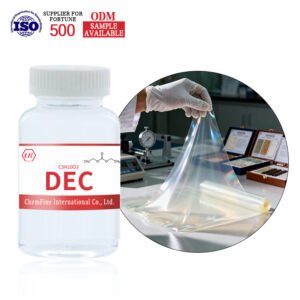
A: DEC is relatively low-volatility compared with many conventional solvents, so it can act as a coalescent and slow drying/evaporation; formulators should adjust solvent blends to achieve desired open time and cure profiles
A: DEC is relatively low-volatility compared with many conventional solvents, so it can act as a coalescent and slow drying/evaporation; formulators should adjust solvent blends to achieve desired open time and cure profiles
Q2: How is DEC typically blended in electrolyte formulations?
A: DEC is usually blended with cyclic carbonates (e.g., ethylene carbonate, propylene carbonate) and linear carbonates (e.g., EMC) along with lithium salts to balance viscosity, conductivity and low-temperature performance
A: DEC is usually blended with cyclic carbonates (e.g., ethylene carbonate, propylene carbonate) and linear carbonates (e.g., EMC) along with lithium salts to balance viscosity, conductivity and low-temperature performance
Q3: Are high-purity grades necessary for synthesis?
A: For sensitive syntheses, use reagent- or anhydrous-grade DEC with documented impurity/water limits
A: For sensitive syntheses, use reagent- or anhydrous-grade DEC with documented impurity/water limits